
Somewhere between 70 and 85 percent of AI projects fail. Not underperform. Not take longer than expected. Fail completely. That is a lot of wasted money, time, and hope. But here is the thing: most of these failures are predictable. They follow patterns. And if you know the patterns, you can avoid them. So let’s talk about why AI projects fail and how to make sure yours does not.
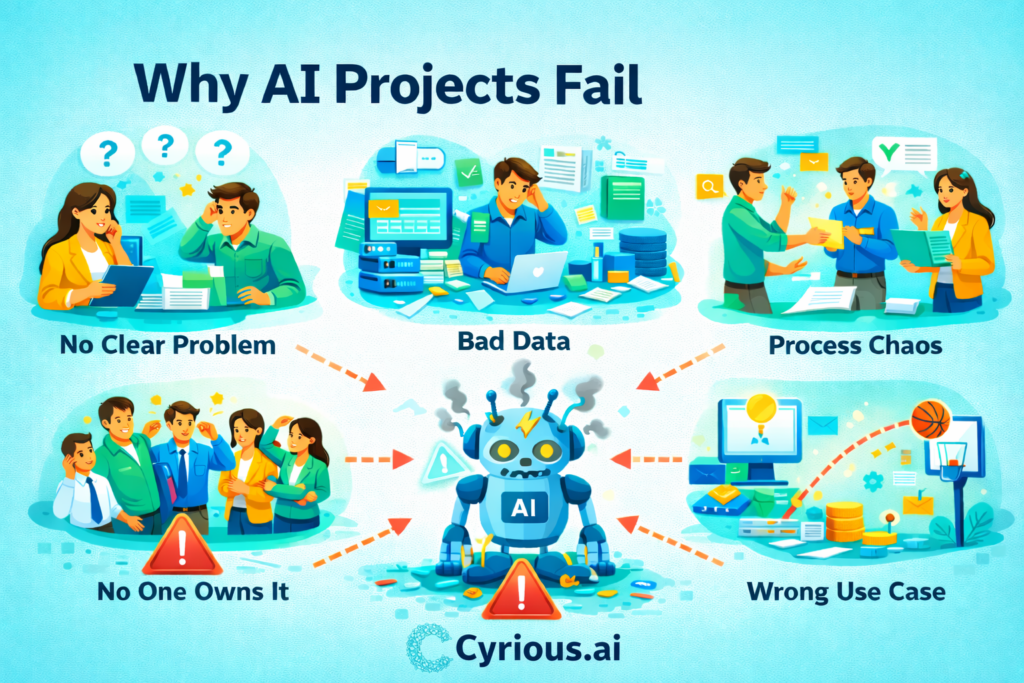
Failure 1: No Clear Problem to Solve
The most common reason AI projects fail is that they start without a clear problem. “We need to do something with AI” is not a problem statement. Neither is “we want to be more efficient” or “our competitors are using it.” When you start with vague goals, you end up with vague results. Or no results at all.
How to avoid it: Start with a specific problem. For example, “We spend 15 hours a week on manual data entry.” Then define what success looks like: “Reduce that to 2 hours a week.” If you cannot clearly state the problem and the value of solving it, you are not ready to start.
Failure 2: Bad Data
AI runs on data. So if your data is messy, incomplete, or locked in systems nobody can access, AI cannot help you. This is the most underestimated issue in small business AI adoption. People think AI is magic. It is not. It is only as good as what you feed it.
How to avoid it: Audit your data before starting any AI project. Be honest about data quality. Plan for data cleanup as part of the project, not an afterthought. Sometimes the right first step is fixing your data, not implementing AI. Because bad data plus AI just means bad results faster.
Failure 3: Process Chaos
You cannot automate a process that does not exist. Or one that changes every time. If your team does things differently depending on who is working or what day it is, AI will just automate the chaos. That is worse than doing nothing.
How to avoid it: Document your processes before trying to automate them. Get agreement on the right way to do things. The best AI projects automate processes that already work. They do not fix broken ones.
Failure 4: No One Owns It
AI projects need someone responsible for making them work. Not a committee. Not “the team.” One person. When no one owns it, no one drives it. Decisions stall, problems do not get solved, and momentum dies.
How to avoid it: Assign a clear owner from day one and give them authority to make decisions. This person does not need to be technical. They just need to care and have time to focus on it.
Failure 5: Team Resistance
AI only works if people actually use it. If your team does not trust it, understand it, or want it, adoption fails. And this is not about bad employees. It is about change management. People resist what they do not understand or what feels like a threat to their job.
How to avoid it: Involve the team early. Ask what would actually help them. Start with something that makes their lives easier, not harder. The best AI implementations are pulled by the team, not pushed by leadership. Gallup research shows that employee buy-in is the single biggest factor in successful workplace technology adoption.
Failure 6: Wrong Use Case
Not every problem should be solved with AI. Sometimes a simpler solution works better. How to avoid it: start with repetitive, rules-based tasks. Look for high-volume, low-complexity work. Save the ambitious stuff for after you have had some wins. Your first AI project should be a layup, not a half-court shot.
Failure 7: Unrealistic Expectations
AI is powerful. It is not magic. When expectations are too high, even successful projects feel like failures. How to avoid it: set realistic, measurable outcomes from the start. Celebrate incremental wins. Underpromise and overdeliver. A small win that actually happens beats a big win that never does.
The Pattern Behind All These Failures
Notice what these failures have in common? They are not really about AI. They are about clarity, data, process, people, and expectations. These are business problems, not technology problems. That is why at Cyrious.ai, we do not start with the technology. We start by getting your house in order first.
How to Set Yourself Up for Success
If you want your AI project to succeed, work through this list before you spend a dollar:
- Start with a clear, specific problem
- Check your data quality honestly
- Document your key processes
- Assign one owner with real authority
- Get team buy-in before launch
- Pick the right use case for where you are today
- Set realistic, measurable expectations
Do these things and you are already ahead of 80 percent of AI projects before you even start.
Start with an Audit
The best way to avoid AI failure is to know exactly where you stand before you start. That is what a Cyrious.ai AI Operations Audit is for. We look at how your business actually runs, identify the real opportunities, and give you a roadmap that sets you up for success from day one.
No hype. No pressure. Just clarity on what to do and in what order.