
Where to start with AI for small business is one of the most common questions we hear. You have decided you want to do something with AI. Good. Now comes the hard part: where do you actually begin? There is so much noise out there. So many tools. So many “AI-powered” everything. It is overwhelming. So let’s cut through it and give you a practical starting point that actually works.
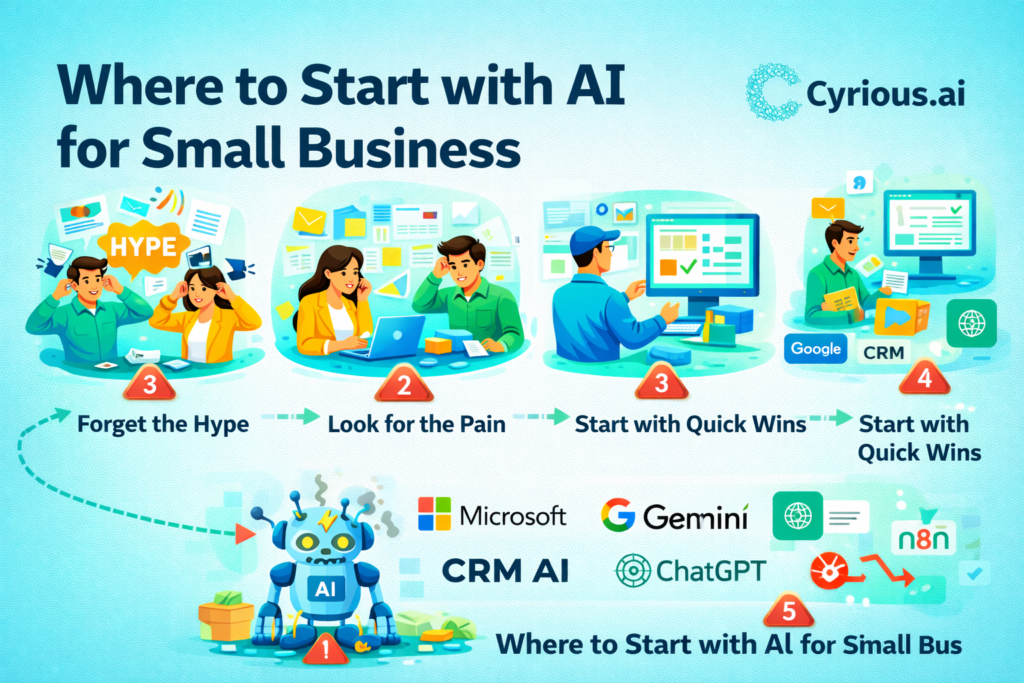
Step 1: Forget the Hype
First things first: ignore 90 percent of what you are reading about AI. The headlines about AI replacing everyone’s jobs? Not worth your time. The case studies about enterprise companies saving millions? That is a completely different world from yours. And the vendors promising AI will transform your business overnight? They are selling something. So tune it all out.
Here is the reality for small businesses: AI is a tool. It can save you time and help you do more with less. However, it is not magic, and it is not going to run your business for you. Start with that realistic mindset and you are already ahead of most people.
Step 2: Look for the Pain
The best place to start with AI for small business is wherever your team is wasting time on repetitive work. Not strategic work. Not creative work. Not relationship work. The boring, repetitive stuff that eats hours every week. Ask yourself:
- What tasks does my team complain about most?
- Where do we spend time copying and pasting between systems?
- What reports take forever to pull together?
- What questions do we answer over and over again?
- What processes are tedious but necessary?
That is where AI can help. Those are your starting points. Because the best AI project is the one that solves a real, specific pain you are already feeling every day.
Step 3: Start with Quick Wins
Your first AI project should be easy. Do not start with “transform our entire sales process.” Start with “automate that one report someone builds manually every week.” Quick wins matter because they build confidence in AI, show your team that this stuff actually works, create momentum for bigger projects, and do not cost much if they do not pan out.
Step 4: Use What You Already Have
You do not need to buy expensive new software to get started. Tools you might already have include Microsoft 365 with Copilot built into Word, Excel, and Outlook. Google Workspace has Gemini AI features. Your CRM might have AI features you are not using. ChatGPT is free or low cost and can do a lot on its own. Before buying anything new, check what is already available in your current tools. You might be surprised what you are already paying for and not using.
Step 5: Try Simple Automation First
AI gets all the attention, but simple automation can be just as valuable for small businesses. Tools like Zapier, Make, or n8n can connect your existing software and automate workflows without any AI involved at all. Zapier reports that small businesses save an average of 10 hours per week through basic workflow automation alone. Sometimes what you need is not AI. It is just your existing tools talking to each other.
Step 6: Do Not Try to Do Everything at Once
The biggest mistake small businesses make with AI is trying to do too much at once. You are not going to “implement AI across the organization” on your first try. Instead, you are going to automate one thing, see if it works, learn from it, and then do another thing. That is how this actually works. Anyone telling you otherwise is either selling something or has a much bigger budget than you do.
Step 7: Assign One Owner
Someone needs to be responsible for your AI efforts. Not a committee. One person. This person does not need to be technical. In fact, they just need to care about making it work, have time to focus on it, be willing to learn, and have the authority to make small decisions without asking for permission at every step.
Step 8: Set a Budget for Learning
Accept that you are going to spend some money figuring this out. Maybe it is $50 per month for a ChatGPT subscription or $200 for an automation tool. That is your learning budget. It is okay if some of it does not pan out. Just keep the stakes low until you know what you are doing. Do not bet the farm on your first project.
Step 9: Get Help If You Are Stuck
There is no shame in asking for help. A good consultant can help you identify the right starting point, avoid common mistakes, get to results faster, and build things you do not have time to build yourself. That is exactly what we do at Cyrious.ai. The key is finding someone who understands small business, not someone used to working with enterprises who will overcomplicate everything.
When You Are Ready for More
Once you have some quick wins under your belt, it makes sense to step back and look at the bigger picture. Where are the larger opportunities? What would have the biggest impact? What is the right sequence? That is what a Cyrious.ai AI Operations Audit does. It gives you the full map so you can be strategic, not just tactical. But you do not have to start there. Start small, build confidence, and then think bigger.
The Bottom Line
So where do you start with AI for small business? Look for repetitive, time-wasting tasks. Pick one small thing to automate. Use the tools you already have. Keep it simple. Then learn and build from there. No transformation required. Just steady progress, one small win at a time.