
Is your business ready for AI? It is one of the most common questions small business owners are asking right now. Your competitors are talking about it. Vendors are pitching you on it. And you are wondering if you are falling behind or if you are smart to wait. The good news is you do not have to guess. Here is how to actually figure out where you stand.
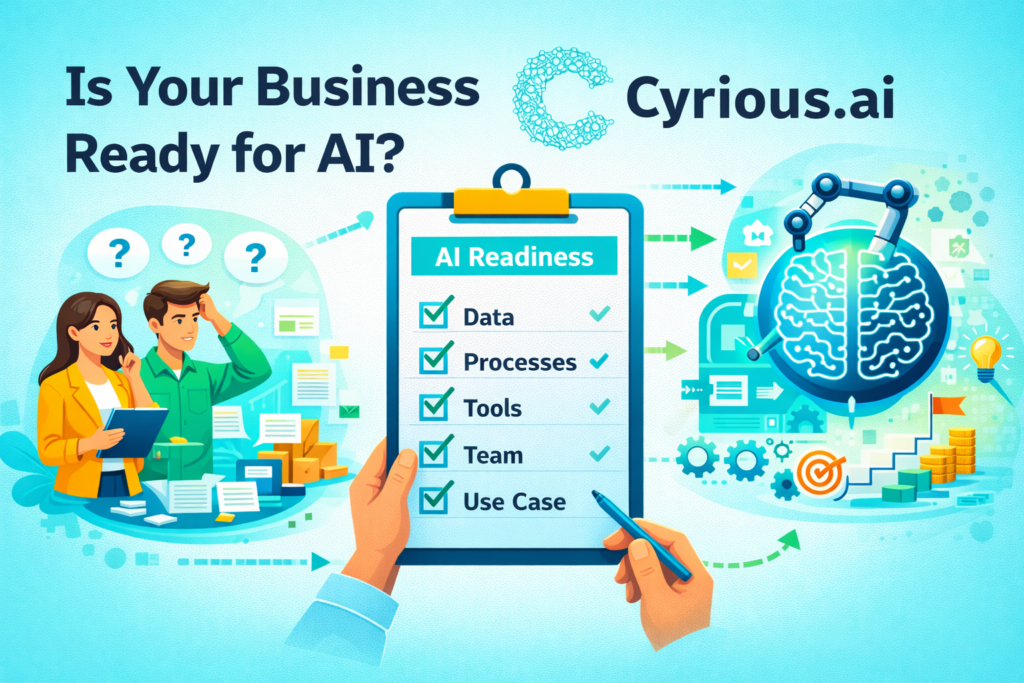
The Quick Self-Assessment
Before we get into details, here is a fast gut check. Answer these five questions honestly:
- Can you pull a report on your key business metrics in under 10 minutes?
- If you asked three employees to describe your sales process, would they give the same answer?
- Do your main software tools connect to each other, or do you copy and paste between them all day?
- If you left for a month, would your team be able to handle things without calling you?
- Can you name one specific task that eats up hours every week and could probably be automated?
If you said yes to four or five of these, you are probably ready to start exploring AI. If you said no to most of them, you have some foundation work to do first. That is okay. At least now you know where to focus.
Sign 1: Your Data Is Accessible
AI runs on data. So if you cannot get to your data easily, AI cannot either. You are ready if your key business data lives in systems you can actually access, you can export reports without jumping through hoops, and you know where to find customer info, sales data, and operational metrics.
You are not ready if critical information lives in someone’s head or personal files, your database is a folder of spreadsheets nobody maintains, or pulling a simple report takes hours. Because messy data does not get fixed by adding AI. It just moves faster.
Sign 2: Your Processes Are Consistent
You cannot automate what is not defined. If everyone does things differently, automation just creates faster inconsistency. You are ready if your key workflows are at least roughly documented, your team follows similar steps for similar tasks, and handoffs between people work smoothly most of the time.
You are not ready if “it depends on who’s doing it” is a common answer in your business. In that case, the first step is documenting how things actually work before layering in any technology.
Sign 3: Your Tools Can Connect
AI needs to plug into your existing systems. If your software cannot talk to each other, AI has nowhere to live. You are ready if your main tools have integrations available, you are already using some basic automation, and your tech stack is relatively modern.
You are not ready if your software is so old it cannot integrate with anything, everything is manual, or your setup is held together with workarounds nobody fully understands. In that case, a technology assessment is a smart first move before anything else.
Sign 4: Your Team Is Open to Change
AI adoption is as much about people as it is about technology. Even the best system fails if your team will not use it. You are ready if leadership is genuinely interested, you have someone who could own this internally, and your team has adopted new technology before without major drama.
You are not ready if “we’ve always done it this way” is the company motto, past technology rollouts have been disasters, or the team is already overwhelmed. Building buy-in before you build the system is always worth the time.
Sign 5: You Know What You Would Use It For
The clearest sign of readiness is knowing what specific problem you are trying to solve. You are ready if you can name specific tasks that waste time every week, you understand that AI solves specific problems rather than everything at once, and you have realistic expectations about what it can do.
You are not ready if your goal is vague, you expect AI to magically fix everything, or you are chasing hype rather than solving real problems. McKinsey research consistently shows that businesses with clearly defined use cases see significantly better results from AI investments. Specificity is everything.
What If You Are Not Ready?
Not being ready is not failure. It is just information. And knowing it now saves you from wasting money later. Here is what to focus on based on where the gaps are:
- Data problems: Start consolidating and cleaning your data.
- Process problems: Document your key workflows, even roughly.
- Tech problems: Evaluate your tools and look for integration options.
- Team problems: Build buy-in and identify an internal champion.
- Clarity problems: Spend time understanding where AI could actually help your specific operation.
Doing this foundation work first means that when you do invest in AI, it actually works. Skipping it means you will probably waste money and end up frustrated.
The Middle Ground: Quick Wins While You Build
What if you are not fully ready but you are not a total mess either? Good news. You can probably still get value from AI through quick wins. At Cyrious.ai, we see this all the time with small businesses.
Quick wins are small, low-risk automations that do not require perfect data or full process documentation. For example, automating a weekly report, setting up auto-responses for common customer questions, creating a simple workflow that routes leads, or using AI to draft emails you review before sending. These let you get real value now while you build the foundation for bigger things later.
The Best Way to Know for Sure
Self-assessment is useful but it is hard to be objective about your own business. That is exactly what a Cyrious.ai AI Operations Audit is for. We spend two weeks talking to your team, mapping your workflows, and looking at how your business actually runs. Then we tell you what is realistic, what the opportunities are, and what to do first.
If you are still wondering whether your business is ready for AI, this is the fastest way to find out.