
So you took a hard look at your business and realized you are not ready for AI yet. Maybe your data is a mess. Maybe your processes are not documented. Maybe your team is not on board. Or maybe you are just not sure what you would even use AI for. That is okay. In fact, most businesses are not ready. The important thing is that you know where you stand. So now what?
First: This Is Actually Good News
Knowing you are not ready for AI is better than pretending you are. Businesses that push forward before they are ready waste money. They buy tools that do not fit, start projects that stall, and frustrate their teams. As a result, they end up worse off than before they started.
You just avoided all of that. Because by being honest about where you are, you can take the right steps in the right order. That is how you actually get results instead of just spending money.
Building the Foundation: What to Fix and How
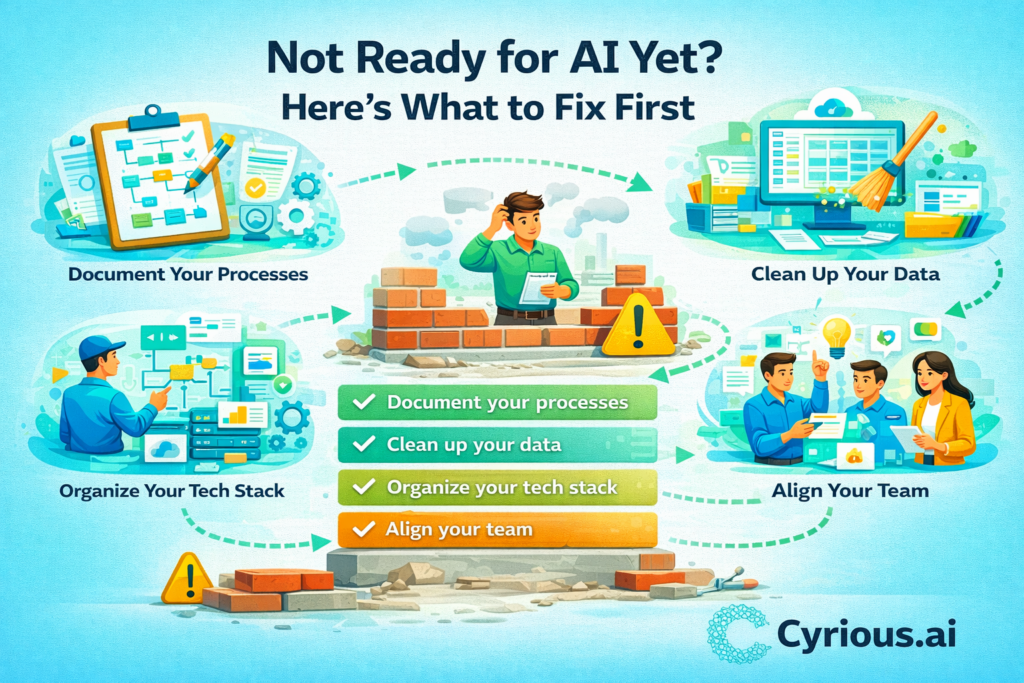
If your business is not ready for AI yet, the work right now is building the foundation. Here is what that looks like depending on where your gaps are.
If Your Data Is the Problem
Start by picking one data set to fix first. Usually that is customer data or sales data. Choose a permanent home for it, whether that is a CRM, a database, or a well-structured spreadsheet. Then clean it up by removing duplicates, filling in gaps, and updating outdated records. Finally, create a process to keep it clean going forward so you do not end up back in the same place in six months. Timeline: 1 to 3 months depending on how messy things are.
If Your Processes Are the Problem
List your five to ten most important workflows. Document them simply: first this, then this, then this. Get agreement from the team on the right way to do each one, and then actually follow them consistently. That documentation does not need to be perfect. It just needs to exist. Timeline: 2 to 4 weeks per major process.
If Your Tech Stack Is the Problem
Map what you have by listing all the software you use and noting which ones can integrate with other tools. Identify the manual handoffs where data does not flow automatically. Then evaluate alternatives for tools that cannot integrate, and connect what you can using tools like Zapier or Make. Timeline: 1 to 2 months for meaningful progress.
If Your Team Is the Problem
First, understand the resistance. Are people scared of change? Overwhelmed? Burned by past failures with new technology? Start with a small win with one willing person and let it spread naturally. Communicate the why clearly and find your internal champion. Timeline: 3 to 6 months to genuinely shift mindset.
If You Lack Use Case Clarity
Learn what is actually possible with AI, not the hype but the reality. Talk to your team about what is tedious and frustrating in their daily work. Prioritize by pain because the best use cases solve problems people feel every single day. Then write down one clear problem statement before you do anything else. Timeline: 2 to 4 weeks of focused attention.
The Right Order of Operations
If multiple things are broken, here is the general order to fix them so you are not spinning your wheels:
- Process first: You cannot improve what is not defined.
- Data second: Clean data requires good processes to stay clean.
- Tech third: Systems should support your processes, not the other way around.
- Team ongoing: Build buy-in throughout the entire journey.
- Use cases last: Once the foundation is solid, the opportunities become much clearer.
Quick Wins While You Build the Foundation
Just because you are not ready for big AI projects does not mean you cannot make progress right now. For example, you can use ChatGPT to draft emails or documents, try a free automation between two tools you already use, or test an AI feature built into software you already pay for. On the process side, document one workflow this week, clean up one spreadsheet, or connect two systems with Zapier. These small steps keep momentum going while you build toward something bigger.
How Long Until You Are Ready?
It depends on how many gaps you have. Minor gaps in one or two areas typically take 1 to 2 months to close. Moderate gaps where the foundation needs real work usually take 3 to 4 months. Significant gaps across multiple areas can take 6 months or more. That might feel slow. But it is still faster than rushing into AI, failing, and having to start over from scratch.
The Bottom Line
At Cyrious.ai, we tell clients this all the time: not being ready for AI is not a failure. It is just where you are right now. Now you know what to work on. Clean and accessible data. Documented and consistent processes. Tools that connect and communicate. A team that is open to change. And clarity on what problems you are actually trying to solve.
Fix the foundation and AI will actually work when you get there. And if you want help building that roadmap, we can help you do it right.